
Accessory Dwelling Units & Junior Accessory Dwelling Units
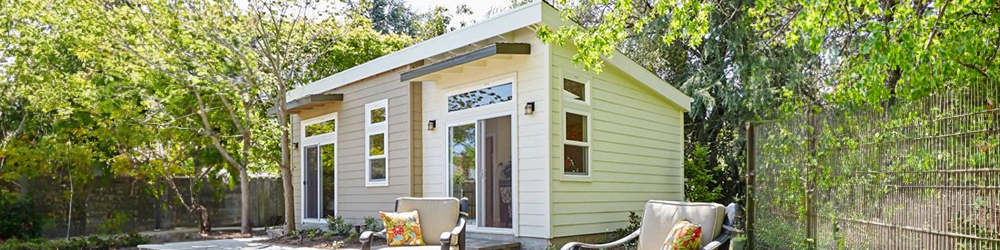
Accessory Dwelling Units (ADUs) and Junior Accessory Dwelling Units (JADUs) are inexpensive ways to create smaller, more affordable rental housing units that may provide revenue streams for property owners while increasing the availability of rental housing in the county. ADUs and JADUs are established secondary to an existing or proposed single-family or multi-family primary dwelling. See Allowability and Zoning for additional information.
A Junior Accessory Dwelling Unit (JADU) is a specific type of ADU that is built within an existing residence, utilizes an existing bedroom, and has a small efficiency kitchen.
Recent changes to State ADU and JADU Law went into effect January 1, 2025
Updates include the following:
- Existing unpermitted ADUs and JADUs created before January 1, 2020, may now be permitted unless the unit is found to be substandard. (Government Code Section 66332)
- Only objective standards described in Gov. Code Section 66323 may be applied to certain types of ADUs. (Government Code Section 66323)
- Up to 8 detached ADUs may now be allowed on a lot with an existing multifamily dwelling (Government Code Section 66323(a)(4)(A)(ii))
Changes to State Law may conflict with the existing Sonoma County ADU Ordinance under Zoning Code Section 26-88-060. The County is working to update local regulations to ensure alignment with State ADU and JADU law. In the meantime, State Law prevails over any conflicts with existing County Code.
What are ADUs and JADUs?
Accessory Dwelling Units (ADUs)
Accessory Dwelling Units (ADUs) are also known as granny units, in-law units, second units, and backyard cottages. An ADU is a small dwelling unit that may be established in addition to single-family or multifamily dwellings in zones where these primary dwellings are allowed.

- Detached: A new construction unit separate from the primary dwelling.
- Attached: A newly constructed unit connected to a primary dwelling or another accessory structure.
- Conversion: A unit created entirely within an existing primary dwelling or accessory structure.
- Combination: A partially converted unit attached to an existing structure with newly constructed elements.
- The quantity, type, and size of ADUs allowed on a lot depends on existing structures, zoning, and site constraints.
- Most residential zoning districts allow ADUs unless the property has the "Z" (Accessory Dwelling Unit Exclusion) overlay combining district.
- ADUs can be rented for long-term occupancy, but they cannot be used as short-term rentals.
Junior Accessory Dwelling Unit (JADU)
A Junior Accessory Dwelling Unit (JADU) is a specific type of ADU that is built within an existing residence, utilizes an existing bedroom, and has a small efficiency kitchen. See Junior Accessory Dwelling Units for information specific to JADUs.
ADUs vs. JADUs vs. Guesthouse
Sonoma County allows several types of residential accessory structures (see Policy 1-4-6, Residential Accessory Structures for a complete list). Below is a summary of the differences among a few of the most common residential accessory structures: Accessory Dwelling Units (ADUs), Junior Accessory Dwelling Units (JADUs), and guest houses.
| Structure Type | Accessory Dwelling Unit | Junior Accessory Dwelling Unit | Guest House |
|---|---|---|---|
| Structure | May be attached to or detached from the main dwelling or accessory structure | Must be created from, and within the footprint of, an existing or proposed single-family dwelling | Accessory building to a single-family dwelling which consists of a detached living area of a permanent type of construction |
| Kitchen | Must have a full kitchen (see Policy 1-4-5, Definition of a Kitchen) | Must have a small kitchen | Cannot have a kitchen or wet bar |
| Bathroom | Must have a full bathroom | Must have direct access to a bathroom, either inside the unit or in the main house | May have a half or full bath |
| Long-Term Rental | Can be rented | Can be rented | Cannot be rented or occupied separately from the main house |
| Transient Rental | May not be used as a vacation rental | May not be used as a vacation rental | May be able to be used as part of a vacation rental or hosted rental with a zoning permit |
| Z Combining District | Prohibited in the Z Combining District | Allowed in the Z Combining District | Allowed in the Z Combining District |
| Size Limit | 1,200 square feet | 500 square feet | 640 square feet |
| Permits Required | Building permit | Building permit | Building permit |
| More Information | Accessory Dwelling Units | Junior Accessory Dwelling Units | 1-4-6 Detached Residential Accessory Structures |
| Zoning Code Reference |
Section 26-88-060 of the Sonoma County Zoning Ordinance. See the County’s ADU website for more information and resources. |
Section 26-88-061 of the Sonoma County Zoning Ordinance. See the County’s JADU website for more information and resources. |
"Guest house" Ordinance No. 6335, 26-4-020, Section G-6 |
Benefits of ADUs
Accessory dwelling units offer a host of benefits to owners, occupants, and the community.
- Rental Income. Not only are ADUs relatively affordable to construct, but they can provide a source of income for homeowners. The ADU Center provides resources for estimating potential rental income and return on investment.
- Increasing Housing Stock. Housing needs well exceed housing supply in California. ADUs add subtle yet valuable density to established areas that may not accommodate larger developments. ADUs may also be used to cater to people at a variety of income levels and can provide as much living space as many newly built apartments and condominiums. They are well suited for couples, small families, friends, young people, disabled people, and seniors.
- Familial and Multigenerational Housing. ADUs allow extended families to live near one another while maintaining privacy and individual spaces. ADUs give homeowners the flexibility to share independent living areas with family members, friends, and others. Among many scenarios, this can mean providing seniors an accessible place to age as they require more care or allowing family members with certain disabilities to obtain a sense of independence while being close at hand.
- Safety and Security. Because ADUs are often occupied by family or friends of the property owner, they can provide additional sets of trustworthy eyes and ears for the neighborhood. This can be especially appealing for homeowners who are concerned about their safety or the security of their property. Having additional people on a parcel may also mean more hands available to respond to crises such as fire or medical emergencies.
- Environmental Benefits. ADUs are generally smaller in size, located on already-developed lots, rely on existing systems for utilities, and are relatively easy to construct for water and energy efficiency compared to a typical single-family home. ADUs are considered a sustainable way of increasing housing stock since they do not require outward urban expansion, take fewer materials to construct, and can help reduce per-housing unit urban impacts. For example, with the addition of an ADU, the same quantity of resource usage and pollutants commonly associated with landscape maintenance may cover the landscaping needs for two homes instead of one.
Want to Build an ADU? Let's get started.

The exact process and requirements for obtaining an ADU depend on the parcel's location. Check our ADU Map Viewer (coming soon) to determine whether your ADU is inland or in the coastal zone.
Inland ADUs
Building an ADU – Concept to Occupancy outlines the process for ADUs outside the coastal zone (parcels without CC zoning).
Coastal ADUs
ADUs in the coastal zone (parcels with CC zoning) have different standards than those outside the coastal zone. While the general seven-step process remains the same, the requirements for each step differ. See Coastal Zone ADUs for more information.
Consider Using ADU Ready! Pre-Reviewed ADU Plans
Sonoma County has developed a program to streamline the permitting process for detached Accessory Dwelling Units (ADUs) through pre-reviewed ADU plans. Plans are submitted by vendors, pre-reviewed by Building Division staff, and included in the ADU Ready Design Gallery.
Applicants can contact listed vendors to purchase pre-reviewed plans and integrate them into their projects. This program aims to reduce the costs, time, and effort associated with designing and permitting ADUs. For more details, visit the ADU Ready website.
 Translate